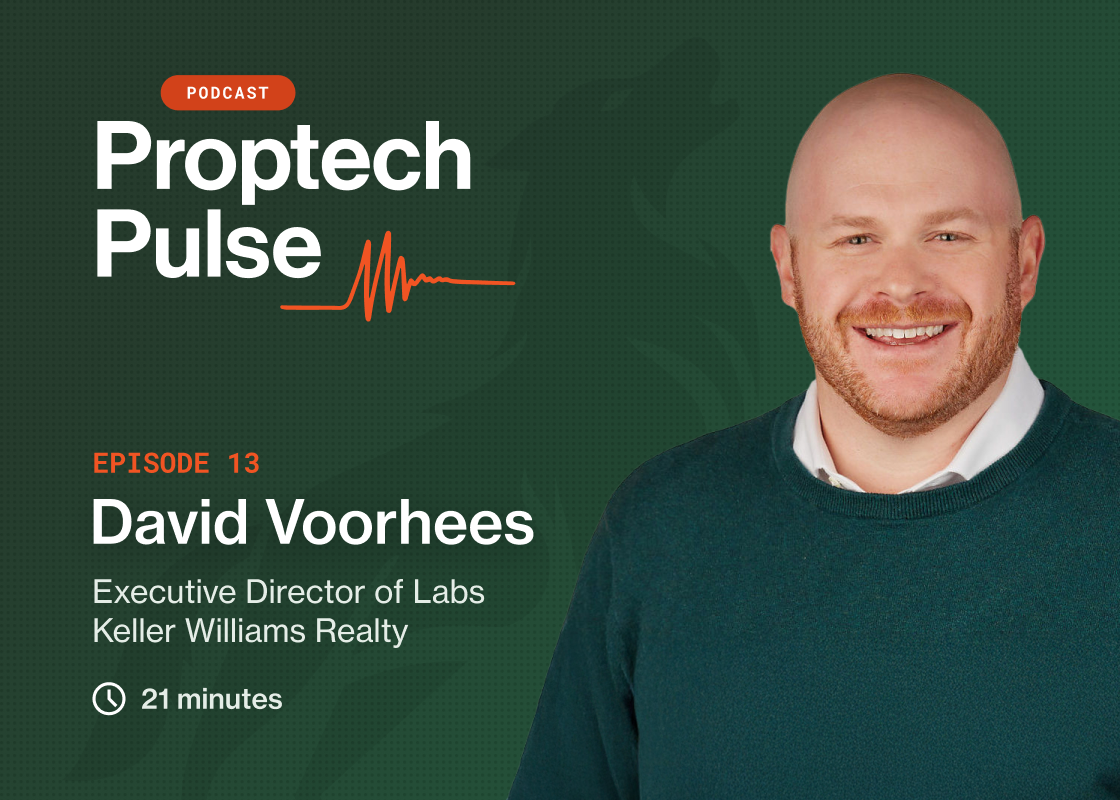
Building real estate tech that works: David Voorhees on agent-centered innovation
How do you build technology that 150,000 real estate agents actually want to use? David Voorhees, Executive Director of Labs at Keller Williams Realty, reveals the unconventional approach that transformed a traditional brokerage into a technology leader. By flying in top-producing agents three times a week and spending entire days understanding their workflows, Keller Williams discovered something most tech companies miss: the gap between what builders think agents need and what actually moves the needle in their business.
In this episode, David shares how his team navigates the delicate balance between building proprietary solutions and partnering with best-in-class technology providers, why staying licensed as an active agent keeps him grounded in reality, and the three-part framework (systems, technology, and people) that guides every product decision. Whether you're trying to close your seventh deal or your seven-hundredth, you'll learn why adoption isn't just about fewer clicks—it's about aligning technology with the proven systems that make agents successful.
Subscribe on your favorite platform:
What you'll discover in this episode.
David Voorhees didn't stumble into technology leadership by accident. As Executive Director of Labs at Keller Williams Realty, he brings a unique perspective shaped by years as a top-producing agent and team leader. His journey from selling real estate to building technology for 150,000 agents across 65 countries gives him rare insight into what agents actually need versus what they think they want.
What sets Keller Williams Labs apart is its foundation in real-world experience. Rather than building technology in isolation, the Labs team flies in high-producing agents three times a week to collaborate on solutions. This approach, championed by Gary Keller himself, ensures every feature addresses genuine pain points that impact an agent's ability to serve clients and close deals. David's continued work as a licensed agent keeps him grounded in the day-to-day realities of the business, informing every decision his team makes.
In an industry flooded with shiny objects and fleeting trends, Keller Williams took a different path. Seven years ago, they made the bold decision to build their own technology rather than continue renting it. This shift sparked a domino effect across the industry, though many who followed have since retreated. David shares the lessons learned from that journey and how the company now balances proprietary innovation with strategic partnerships.
The conversation reveals a fundamental truth about real estate technology: building great tools is only half the battle. Adoption requires training, cultural alignment, and a deep understanding of how agents actually work. David explains how Keller Williams leverages its training DNA—rooted in Gary Keller's bestselling book, The Millionaire Real Estate Agent—to transform technology from a nice-to-have into an operational necessity. The results speak for themselves: agents with 200+ contacts in their database are three times more likely to reach production caps.
For agents overwhelmed by technology choices or brokers evaluating enterprise solutions, this episode cuts through the noise. David shares the exact framework Keller Williams uses to evaluate technology partners, the mistakes they made early on by focusing too heavily on top producers, and why AI will change how agents operate without replacing them. Whether you're a solo agent looking to scale or a broker managing hundreds of agents across multiple markets, these insights will reshape how you think about technology's role in your business.

This episode explores:
- The Labs methodology — How Keller Williams identifies the biggest problems worth solving by bringing top producers into collaborative sessions, and why they now prioritize diverse agent perspectives from brand-new licensees to veterans closing thousands of transactions annually.
- Technology build vs. buy decisions — The evolution from a "build everything ourselves" approach to strategic partnerships, including the matrix David uses to evaluate whether a problem requires proprietary technology or an integration partner.
- Scale as a selection criteria — Why serving 150,000 agents in 65 countries with native support in 24 languages creates unique challenges when evaluating technology partners, and how companies can position themselves to meet enterprise needs.
- Training as the adoption engine — How Keller Williams transformed Gary Keller's Millionaire Real Estate Agent framework into an operations manual for their technology, ensuring agents don't just have tools but know exactly how to use them for maximum impact.
- The three-part solution framework — Why agents need systems and models first, technology second, and people third to solve business problems, and how rushing to hire rather than implementing processes leads to expensive, inefficient solutions.
- Data-driven performance indicators — Specific benchmarks that predict agent success, like the 200-contact database threshold that makes agents three times more likely to cap, and how technology teams use these insights to guide product development.
- AI's role in real estate operations — David's perspective on how artificial intelligence will transform agent workflows without replacing the human element, plus Keller Williams' approach to implementing AI features that deliver genuine value rather than checking boxes.
- Regional and international complexity — The operational challenges of supporting agents across multiple countries, from currency conversions and measurement systems to regulatory compliance and cultural nuances in how real estate is practiced.
- Partnership evaluation criteria — The specific questions David asks when assessing technology vendors: Does it solve a real problem for our agents? Can the company scale to our user base? Is there a clear path forward even if they're not ready today?
- Learning from early mistakes — Why focusing exclusively on top producers in the early days limited the technology's reach, and how broadening input to include agents at all production levels created tools with universal appeal and application.
- Command platform evolution — The strategic decision to build a solid core foundation first, then lean heavily into choosing the right integration partners moving forward, creating an ecosystem that serves diverse agent needs without trying to build everything in-house.
- Measuring technology impact — How Keller Williams tracks monthly active users (120,000-130,000 consistently), correlates specific activities with production outcomes, and uses these insights to guide both product development and agent training initiatives.
Insights you can apply starting today

The most common mistake in real estate technology development is building for the agent you wish existed rather than the agent who actually uses your platform. David learned this lesson early when Keller Williams Labs initially focused exclusively on top producers—agents selling hundreds of homes annually. While these high performers provided valuable insights about complex workflows, the resulting technology didn't always serve agents doing 7 or 12 deals per year.
"We've been chartered by Gary to go build technology that helps every agent in our company have an unfair advantage, whether they got their license yesterday or they're in the top one tenth of 1% of agents in our company," David explains. This shift required fundamental changes to how Labs approached product development.
The breakthrough came when they started intentionally seeking diverse producer profiles. They began talking to agents who had been with the company just three months alongside 20-year veterans, and agents selling a dozen homes alongside those selling hundreds. This revealed that the difference between an agent staying in the business or leaving might be just one or two additional transactions per year—something technology could directly influence.
For brokers evaluating new platforms, this insight is critical. Ask vendors: "Who did you build this for?" If the answer focuses only on top performers or team leaders, consider whether the technology will actually serve your entire agent population. The best platforms scale down as well as up, providing value to agents regardless of production level.

About David Voorhees
David Voorhees serves as Executive Director of Labs at Keller Williams Realty, where he leads the charge in shaping technology strategy and user experience for one of the largest real estate networks in the world. With more than 20 years of leadership experience and nearly a decade focused specifically on transforming the customer and team member journey in high-value sales environments, David brings a unique perspective to the intersection of technology and human-centered design. At Keller Williams, he guides cross-functional teams responsible for empowering over 150,000 associates globally, managing everything from strategic partnerships with major technology companies to go-to-market strategy and platform adoption across diverse markets.
Connect with David Voorhees:
FAQ about this episode.
Keller Williams Labs tackles the fundamental disconnect between technology builders and end users in real estate. Unlike Starbucks where everyone drinks the coffee they make, the people building real estate technology rarely use it themselves. David Voorhees explains that his team of twelve wakes up every day to identify the biggest problems they can solve for the most people—problems that give agents back time and empower them to make more money. The challenge extends beyond simple feature development: agents and franchisees interpret technology differently, making that final translation from concept to adoption particularly difficult. Labs bridges this gap by maintaining constant contact with actual producing agents, from those who just got licensed to top producers closing thousands of transactions annually.
Related episodes: Continue your learning journey.
Episode 6: How to partner with a tech vendor with Vanessa Bergmark
Learn complementary vendor selection strategies from a broker with 15 years of experience making technology partnership decisions.
Episode 7: Tech-enabled relationships with Laurie Weston Davis
Discover how technology supports rather than replaces the relationship-building that drives real estate success.
Episode 8: Making sense of real estate's biggest consolidations with Craig McClelland
Explore how industry consolidation is reshaping the competitive landscape and what it means for technology strategy.
Mentioned in this episode
Guest contact:
- David Voorhees — Executive Director of Labs, Keller Williams Realty
- David leads the innovation team at Keller Williams, responsible for identifying and solving the biggest challenges facing real estate agents through technology and strategic partnerships.
Key concepts discussed:
- Labs as innovation hub: How Keller Williams Labs operates as a dedicated team identifying problems worth solving for agents and franchisees.
- Agent-centered product development: The methodology of flying in top producers three times weekly to inform technology builds.
- Command platform evolution: The journey from renting technology to building a native platform supporting 120,000+ monthly active users.
- Technology partnership strategy: Framework for evaluating potential integrations based on problem-solving capability, scale, and agent needs.
- Adoption through training: Leveraging Keller Williams' education-first culture and "The Millionaire Real Estate Agent" framework to drive platform usage.
- Global scale challenges: Managing technology deployment across 63+ countries in 24 native languages.
- The three-part solution framework: Systems and models first, then technology, then people—prioritizing the most efficient solutions.
- Data-driven success metrics: Using insights like "agents with 200+ contacts are 3x more likely to cap" to target training and drive adoption.
- Building vs. buying decision matrix: How to evaluate when to develop proprietary technology versus partnering with existing solutions.
- AI's role in real estate: The future of AI as an agent enabler rather than replacement, with emphasis on practical application and training.
- Diverse agent feedback: The importance of gathering input from new agents, mid-level producers, and top performers to build inclusive technology.
- Technology as competitive advantage: Creating unfair advantages for agents at every production level through integrated, user-friendly platforms.
Connect with PropTech Pulse:
Transform your tech today
David’s journey reveals that true innovation isn't about having the most features—it’s about having the right systems that agents actually use. At Lone Wolf, we bridge the gap between developer vision and real-world workflows by building technology rooted in the day-to-day realities of the business. Discover how to align your technology with the proven systems that build a lasting competitive advantage.
Explore our solutions